
THE ULTIMATE GUIDE TO HUMANITARIAN & COMPASSIONATE (H&C) APPLICATIONS IN CANADA

THE ULTIMATE GUIDE TO HUMANITARIAN & COMPASSIONATE (H&C) APPLICATIONS IN CANADA
Understanding When, Why, and How to Apply for Permanent Residence on Humanitarian Grounds
What Is an H&C Application?
A Humanitarian and Compassionate (H&C) application is a last-resort pathway for individuals who are in Canada and do not qualify for any other immigration program, but who have compelling reasons why they should be allowed to stay permanently. It is designed for those who would face unfair hardship, risk, or disproportionate consequences if forced to return to their home country.
Unlike Express Entry or family sponsorship, the Humanitarian and Compassionate (H&C) application is discretionary. Meaning immigration officers must look at the entire context of a person’s life, struggles, establishment in Canada, and the best interests of any children affected.
Who Is the H&C Program For?
People typically apply for Humanitarian and Compassionate (H&C) when they:
People typically turn to a Humanitarian and Compassionate (H&C) application when they have no other immigration pathway available but have compelling reasons to remain in Canada. This option is often used by individuals who have lived in Canada for many years without legal status, permanent residents who do not meet the 730-day residency obligation, or those who became out of status as workers, visitors, or international students. Many applicants cannot safely or realistically return to their home countries because of significant personal hardship, though not necessarily the type of risk covered under refugee law. Others are caregivers or supporting vulnerable family members in Canada, or would face severe financial, emotional, or social hardship if forced to leave. Humanitarian and Compassionate (H&C) applications are also commonly used by parents of Canadian-born children, individuals who have experienced abuse or trauma, and those who, despite falling out of status, have strong roots, employment, and community ties in Canada.
Here are some common examples of the types of H&C applications filed:
- Have lived in Canada for many years without status
- Do not meet the residency obligation as a Permanent Resident
- Are out-of-status workers, visitors, or international students
- Cannot return to your country because of personal hardship (not refugee-level risk)
- Are caregivers or supporting vulnerable relatives
- Would face extreme financial, emotional, or social hardship abroad
- Have Canadian-born children who depend on you
- Experienced abuse, trauma, or circumstances beyond your control
- Fell out of status but have strong establishment in Canada
H&C is not about fear of persecution (that belongs to refugee law). It is about hardship, equity, compassion, family unity, and humanitarian need.
Core Factors Immigration Officers Consider
A. Establishment in Canada
One of the core elements in a Humanitarian and Compassionate application is the applicant’s level of establishment in Canada. Decision-makers look closely at how deeply and meaningfully the applicant has integrated into Canadian society. This includes examining consistent employment history, payment of taxes, and efforts to maintain financial independence. Officers also consider whether the applicant has completed education in Canada, developed meaningful friendships, and established emotional support networks. Stable housing, long-term community involvement, and evidence of social integration all reinforce that the applicant has built a life rooted in Canada. The stronger the establishment, the more persuasive the argument that removal would be unfair or disproportionate.
B. Hardship If Forced to Return
Hardship upon return is the central focus of any H&C application. Officers assess not only the general conditions in the applicant’s home country but also the specific, personalized challenges the individual would face. This includes lack of family support, high economic or social vulnerability, unsafe or unstable living conditions, limited access to medical treatment, or gender-based risks. They also consider whether the applicant may face discrimination due to religion, gender, sexual orientation, or other identity factors. Past trauma, ongoing emotional instability, or other vulnerabilities further strengthen the hardship argument. The goal is to demonstrate that returning would impose consequences that are unusual, excessive, or undeserved.
C. Best Interests of Any Children
The best interests of any children affected by the decision are given the highest priority. Officers must carefully evaluate how removal would impact a child’s physical safety, access to education, medical care, psychological well-being, and overall stability. If the child is a Canadian citizen or has been raised primarily in Canada, these factors carry significant weight. Strong attachments to school, community, friends, and their established environment make disruption particularly harmful. Even if the adult’s case on its own is not strong, compelling evidence showing that a child would suffer negatively can result in a successful H&C application, as Canadian law requires that children’s interests remain a primary consideration.
D. Good Character & Conduct
An applicant’s behavior and respect for Canadian laws are also key considerations. Officers look for evidence of good character, demonstrated by a clean criminal record, compliance with immigration conditions where possible, and a genuine effort to remain lawful. If mistakes were made, such as falling out of status, officers expect to see honesty, consistency, and remorse. Transparent explanations, evidence of responsibility, and documented contributions to society help establish credibility. Strong character significantly enhances the discretionary aspect of an H&C application.
E. Gender-Based Factors (NEW IRCC Policy)
Recent IRCC policy updates require decision-makers to explicitly consider gender-based hardship. This includes situations involving domestic violence, forced marriage, gender oppression, and cultural norms that may disproportionately impact women, girls, or gender-diverse individuals. Officers also examine the vulnerability of LGBTQ+ applicants who may face hostility, discrimination, or danger in their home countries. These factors recognize that certain individuals face unique risks that may not be captured by traditional refugee or immigration categories, but still warrant protection under humanitarian and compassionate grounds.
Who Should Not Apply for H&C?
Humanitarian and Compassionate (H&C) applications are not suitable for everyone, and filing one at the wrong time can lead to wasted time, money, and even negative consequences. A Humanitarian and Compassionate (H&C) application is not recommended for individuals who are outside Canada, as the program is intended strictly for applicants already inside the country. It is also not appropriate for those who currently have an active refugee claim, nor for people who have recently received a negative Pre-Removal Risk Assessment (PRRA), since the law prevents H&C submissions based on risk factors already assessed through refugee or PRRA processes. H&C is also not a solution for individuals trying to avoid criminal inadmissibility, as this requires entirely different legal avenues. Finally, anyone who is eligible to apply through a regular immigration program such as Express Entry, Provincial Nominee Programs, or spousal sponsorship should pursue those options instead. The H&C process is intended as a last resort, reserved for people who have no other possible pathway to stay in Canada but whose circumstances warrant compassion and special consideration.
What Makes a Strong H&C Application?
A compelling H&C submission includes:
- A detailed personal statement
- Evidence of hardship (proof, not just claims)
- Psychological or medical reports
- Letters of support
- Employment records
- Tax filings
- School records for children
- Proof of community and establishment
- Country condition reports
- Photographs, messages, affidavits
- Legal submission letter connecting facts to law
Narrative consistency is critical. Officers must clearly understand your life story and why returning would be unfair.
Common Mistakes That Lead to Refusal
Many Humanitarian and Compassionate (H&C) applications are refused not because the applicant lacks genuine hardship, but because the submission is incomplete, unclear, or poorly supported. The most common mistakes include providing insufficient evidence, which makes it difficult for an officer to understand the full picture of the applicant’s life in Canada and the hardship they would face abroad. Another frequent issue is a weak or vague personal narrative. Stories that are generic, contradictory, or lacking detail often fail to establish credibility. Some applicants mistakenly assume that sympathy alone will secure approval, without realizing that H&C decisions rely heavily on documented facts, not emotion. Failure to highlight the best interests of children, which is a primary factor, greatly weakens a case. Others harm their applications by withholding information, intentionally or unintentionally, which can be interpreted as dishonesty. Additionally, not clearly demonstrating hardship in the home country, failing to show strong establishment in Canada, or submitting disorganized, incomplete files all increase the risk of refusal. H&C cases demand careful preparation, strong evidence, and a compelling, well-structured narrative. Without these, approvals are rare.
Again, avoid these common mistakes:
- Not providing enough evidence
- Weak personal story. Vague, generic, or contradictory
- Assuming “sympathy” will be enough
- Not including children’s best interests
- Hiding information
- Not showing hardship in home country
- Not demonstrating establishment in Canada
- Poor organization or missing documents
How Akrami & Associates Helps With H&C Applications
H&C applications are among the most complex immigration submissions because they are built on legal argument, evidence, and persuasive storytelling, not formulas. Our firm specializes in:
- Identifying the strongest H&C angles
- Drafting powerful personal narratives
- Preparing detailed legal submissions
- Collecting and organizing evidence
- Highlighting hardship and child rights
- Presenting risk-based country conditions
- Ensuring full compliance with IRPA s.25
- Responding to procedural fairness letters
We handle cases involving families, single parents, out-of-status workers, failed refugee claimants, PR card residency issues, and victims of hardship or abuse.
Latest Immigrations News
June 26, 2026
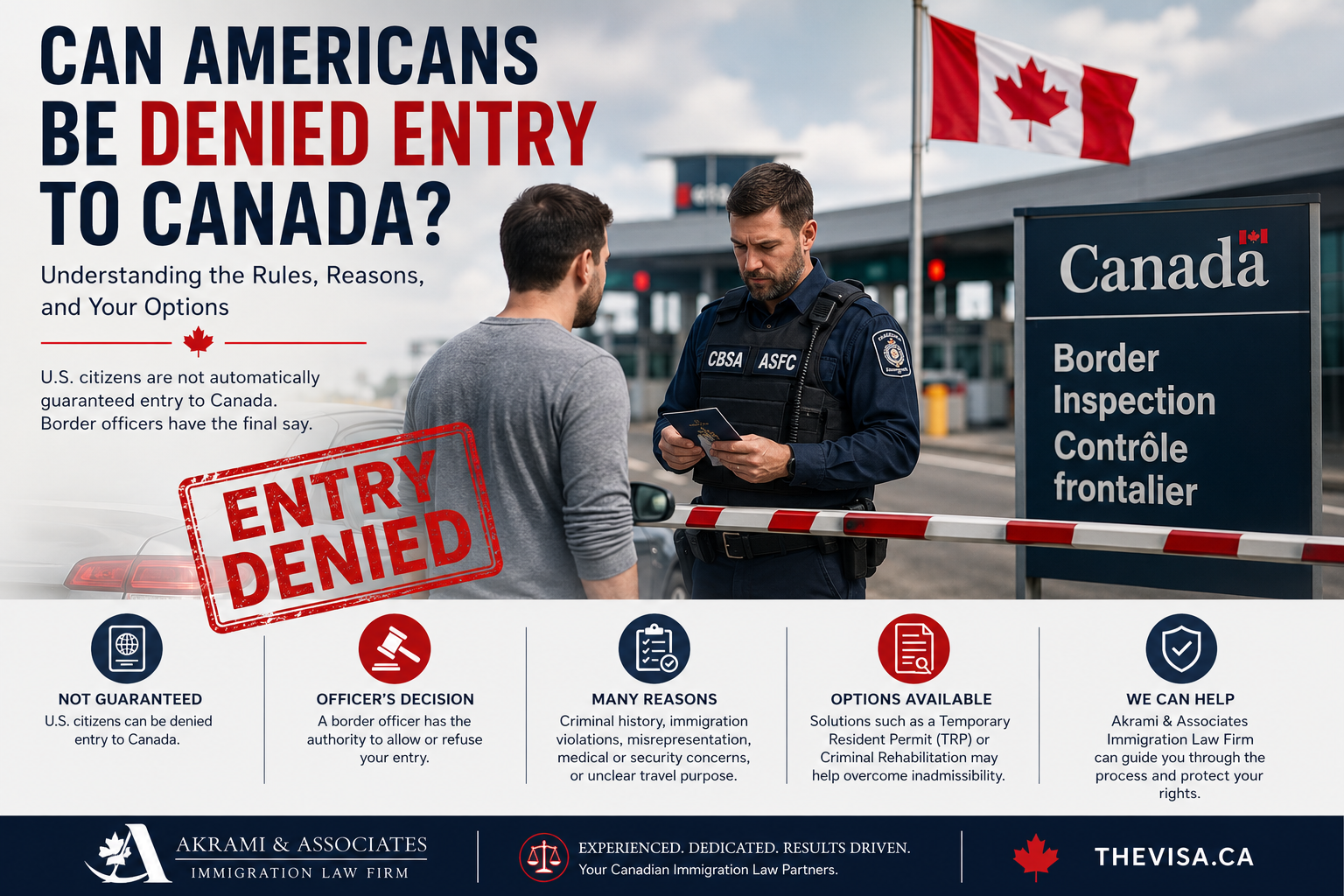
Can Americans Be Denied Entry to Canada?
Can Americans Be Denied Entry to Canada?Yes, Americans can be denied entry to Canada. Although United States citizens are visa-exempt for many short visits, entry into Canada is never automatically guaranteed. Admission is still decided by a Canadian border services officer at the airport, land border, or other [...]

September 11, 2025
Canada Super Visa: Step-by-Step Guide for Parents and Grandparents
For many Canadian citizens and permanent residents, bringing parents or grandparents to Canada for extended visits is more than just a wish, it’s a heartfelt need. While most people first consider the traditional visitor visa, there is another option designed specifically for family reunification: Super Visa applications. [...]

August 23, 2025
Intra-Company Transfer (ICT) Work Permit, Your Complete Guide to Working in Canada
For multinational companies, moving key talent across borders is often essential for growth and operational success. The Intra-Company Transfer (ICT) Work Permit provides a streamlined pathway to bring experienced employees to Canada without the time-consuming Labour Market Impact Assessment (LMIA) process. For foreign professionals, it’s more than [...]

Book a Conslutation
One of our Representatives will
assist you with your matter. Book Now!
Click here

Call us for
more Information
+1-416-477-2545
Toll Free: 1-877-820-7121
Click here

Write Us (Online Form)
Complete our form and one of our
Representatives will contact you.
Click here

Subscribe To Our Newsletter

 1440 Hurontario St
 Whats App: +1 416-477-2545
 Email: info@thevisa.ca