
Top 5 Immigration Pathways to Canada: Which One Is Right for You?

When someone asks, “What are my immigration options?” it’s a bit like asking, “What kind of car should I buy?” The answer isn’t one-size-fits-all. Your immigration pathway depends on many factors—your background, your career goals, your family situation, financial resources, and more. At Akrami & Associates, we know that every client has a unique story, and that’s why personalized consultations are our first recommendation. Emailing questions is fine, but nothing compares to a real conversation where we can fully evaluate your circumstances and tailor advice just for you.
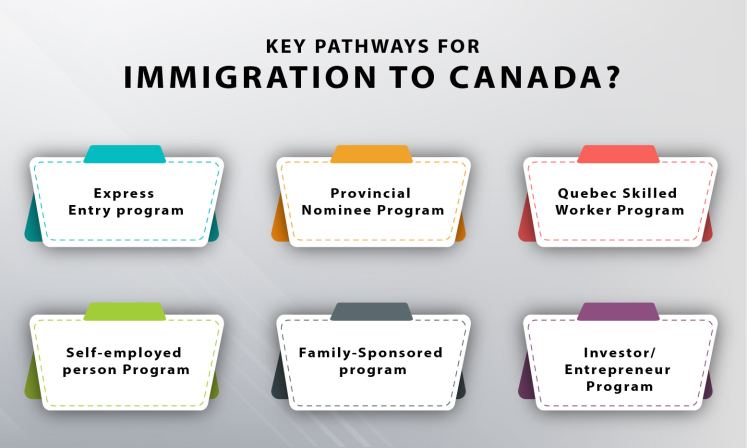
Still, if you’re just starting your research, here’s a comprehensive breakdown of the five major immigration pathways to Canada—the broad umbrellas under which most applications fall.
1. From Temporary to Permanent Residency: A Smart Strategic Approach
One of the most common ways to immigrate to Canada is to come first as a temporary resident and then transition to permanent residency. Many newcomers arrive on visitor visas, study permits, or work permits before making Canada their permanent home.
For example, a visitor who later considers work needs a separate assessment of work-permit eligibility and the correct application process. A visit or job offer does not itself authorize work or guarantee that an application can be made from inside Canada.
International students often use the Post-Graduation Work Permit (PGWP) to gain Canadian work experience after completing their studies. From there, many apply through the Express Entry system under the Canadian Experience Class (CEC) program, which is designed for those with Canadian work experience.
This pathway lets you establish yourself in Canada first, gain valuable work experience, and adjust to life here before applying to become a permanent resident.
2. Economic Immigration: Express Entry and Other Streams
Canada’s economic immigration programs aim to attract newcomers who will contribute to the country’s economic growth. The most well-known program is the Express Entry system, which operates on a points-based ranking.
Applicants receive points based on several factors, including age, education, language skills in English or French, and work experience—especially Canadian work experience. The younger and more educated you are, and the stronger your language abilities, the better your chances of being invited to apply for permanent residence.
But Express Entry isn’t the only economic pathway. For example, the Caregiver Program addresses Canada’s growing need for child care and elder care professionals. Caregiver pathways have their own eligibility and intake rules. Confirm the specific program’s current status rather than assuming it is open or easier than Express Entry.
In addition, Provincial Nominee Programs (PNPs) provide targeted opportunities for skilled workers tailored to the labor needs of each province or territory. Some provinces also offer streams dedicated to semi-skilled workers and in-demand occupations, broadening the possibilities beyond Express Entry.
What Factors Influence Your Immigration Options?
Before recommending a pathway, we consider several personal factors, including:
- Age: Younger applicants often earn more points in economic programs.
- Education: Higher education opens more doors.
- Work Experience: Especially in high-demand occupations or Canadian experience.
- Language Proficiency: English and French skills are vital across most programs.
- Financial Resources: Particularly important for business immigration and study permits.
- Job Offers: Relevance depends on the program and current criteria; an offer is not an approval or invitation.
These elements combine uniquely for each applicant, influencing which pathways are most realistic and effective.

3. Humanitarian and Compassionate (H&C) and Refugee Applications
While these pathways are not the first options we recommend, they address distinct legal circumstances and should not be treated as interchangeable fallback applications. Humanitarian and Compassionate (H&C) applications are for individuals who have already established themselves in Canada and face serious hardship if forced to return to their home country.
Refugee claims require applicants to prove a genuine fear of persecution due to factors such as race, religion, political opinion, or membership in a particular social group. These cases are highly sensitive and complex, with significant risks involved if refused, including deportation and future inadmissibility.
Because of the high stakes, it’s crucial to approach H&C and refugee applications with expert legal guidance. The wrong approach can lead to devastating consequences, so these options should only be pursued after thorough consultation.
4. Business and Investor Immigration Programs
If you are an entrepreneur or investor, Canada offers specialized immigration streams designed for business immigrants. These pathways allow you to immigrate by establishing, investing in, or managing a business in Canada.
The Start-Up Visa Program is popular among innovative entrepreneurs who have secured support from a designated Canadian venture capital fund, angel investor, or business incubator. Check the Start-up Visa program’s current intake status and detailed requirements before relying on its historical description as an available route.
Provincial Nominee Programs also include business streams requiring investment in a local enterprise, active management, and job creation. While these programs usually demand a significant financial commitment, any nomination and permanent-residence steps have separate conditions and do not guarantee approval.
Each province’s business immigration requirements and investment thresholds vary, so a consultation is essential to identify the best program based on your business goals and resources.
5. Family Sponsorship: Keeping Families Together
One of Canada’s most heartwarming immigration programs is family sponsorship, which allows citizens and permanent residents to sponsor loved ones to come and live in Canada.
Eligible sponsored family members include spouses, common-law or conjugal partners, eligible dependent children, parents, and grandparents (subject to specific intake periods and limits). In rare cases, other relatives may qualify under special provisions like the “Lonely Canadian” rule, but this is very limited.
A common misconception is that extended family members—such as aunts, uncles, or cousins—can be sponsored easily. This is generally not the case unless they meet strict criteria in exceptional circumstances.
Family sponsorship programs require careful attention to detail to avoid processing delays or refusals. Proper documentation, evidence of genuine relationships, and thorough applications are critical to success.
Why You Need a Consultation to Find the Right Pathway
Because everyone’s story is different, it’s essential to receive personalized advice. Some clients come with excellent education and language skills but limited work experience. Others have years of work history but less formal education. Your combination of strengths and challenges determines the best immigration options.
A consultation allows us to assess your individual profile and recommend the most efficient and promising pathway. At Akrami & Associates, you’re never just an application number—you’re a unique person or family embarking on an important new chapter.
Frequently Asked Questions
Can I get permanent residency after coming to Canada on a visitor visa?
A visitor visa does not grant a right to work or permanent residence. A person must qualify separately for any work permit, nomination or PR program and follow the appropriate application process.
Is Express Entry my only economic immigration option?
No. Programs like the Caregiver Program, provincial nominee streams, and business immigration offer other routes.
Can I sponsor my niece or nephew to come to Canada?
Generally, no. Family sponsorship is mainly for spouses, dependent children, and parents. Extended family sponsorship is limited to exceptional cases.
Do I need to take an English test?
Most economic immigration programs require approved language tests such as IELTS or CELPIP.
Are business immigration programs only for millionaires?
Not necessarily. While financial proof is required, provincial streams sometimes offer options for smaller investments.
What happens if my refugee or H&C application is refused?
Refusal can lead to deportation. These applications should be pursued carefully with expert legal help.
Let’s Build Your Immigration Pathway Together
Immigrating to Canada isn’t about ticking boxes; it’s about finding the right fit for your skills, goals, and family. Whether you want to study, work, invest, or reunite with loved ones, Akrami & Associates is here to guide you.
Our team assists individuals and families with assessing immigration requirements and organizing their applications. We prepare complete, compelling applications that present the relevant evidence clearly; no pathway or representative can guarantee approval.
If you’re ready to explore your immigration options, contact Akrami & Associates today for a personalized consultation. Your Canadian journey begins with the right advice—and we’re here to help every step of the way.
Use a practical comparison before choosing a pathway
Start with your current status, location, family circumstances, work history, language results and education records. Separate the conditions that let you apply from the factors that affect selection. A person may meet a program’s minimum requirements without being invited, nominated or approved.
For economic immigration, our Express Entry service can help assess the relevant federal program and current selection criteria. For an eligible family relationship, our Family Class Sponsorship service addresses a different set of sponsor and applicant requirements. Do not compare these solely by a processing estimate from an old article.
If your immediate plan concerns work or study, review Work Permit Canada and Study Permit Canada separately from any eventual permanent-residence plan. For an in-Canada humanitarian request, consult IRCC’s H&C guide before assuming eligibility or protection from removal.
Book a consultation to compare Canadian immigration options with the records supporting your actual circumstances. Ask which requirements are met, which evidence is missing and which assumptions depend on future selection or policy decisions.
Latest Immigrations News

March 13, 2025
How to Immigrate to Canada: Compare Pathways and Requirements
Choosing how to immigrate to Canada starts with your circumstances, not a ranking of supposedly easy programs. Employment history, education, language results, family relationships, intended destination and immigration status can lead to different assessments. A route that worked for another person may not be available [...]

June 21, 2024
How to Immigrate to Canada: Permanent and Temporary Pathways Compared
How to Immigrate to Canada Canada is known for its welcoming attitude towards immigrants, its high quality of life, and its vast opportunities for personal and professional growth. With its diverse culture, excellent healthcare system, and strong economy, it's no wonder that Canada is a top destination for [...]

June 1, 2023
Searching for Jobs in Canada: Essential Information
When it comes to searching for jobs in Canada, there are various important avenues you can explore. Consider the following tips and resources to enhance your job search! Research Companies: Take the time to identify companies that align with your career goals. Visit their websites to check for any job [...]



Book a Conslutation
One of our Representatives will
assist you with your matter. Book Now!
Click here

Call us for
more Information
+1-416-477-2545
Toll Free: 1-877-820-7121
Click here

Write Us (Online Form)
Complete our form and one of our
Representatives will contact you.
Click here

Subscribe To Our Newsletter

 1440 Hurontario St
 Whats App: +1 416-477-2545
 Email: info@thevisa.ca