
How to Get an Intra-Company Transfer Work Permit in Canada
How to get an Intra-Company Transfer Work Permit
Are you wondering how to get an Intra Company Transfer work permit? The Intra-Company Transfer (ICT) Work Permit offers a streamlined pathway for companies to transfer key personnel to their Canadian branches. This permit allows skilled workers to leverage their expertise and contribute to the Canadian economy while gaining invaluable international experience. Whether you’re a business executive, manager, or a specialized knowledge worker, understanding the intricacies of how to get an intracompany Transfer Work Permit or ICT Work Permit can open doors to new opportunities in Canada.
What is an Intra-Company Transfer Work Permit?
An Intra-Company Transfer Work Permit enables companies to transfer employees from a foreign branch to a Canadian branch. The primary objective is to allow Canadian companies to benefit from the expertise of their global workforce, ensuring business continuity and fostering international business relations.
Eligibility Criteria
For Employers:
- Presence: The employer must have a qualifying relationship with the foreign company. This includes parent companies, branches, subsidiaries, or affiliates.
- Active Business Operations: The Canadian branch must be operational and actively conducting business.
For Employees:
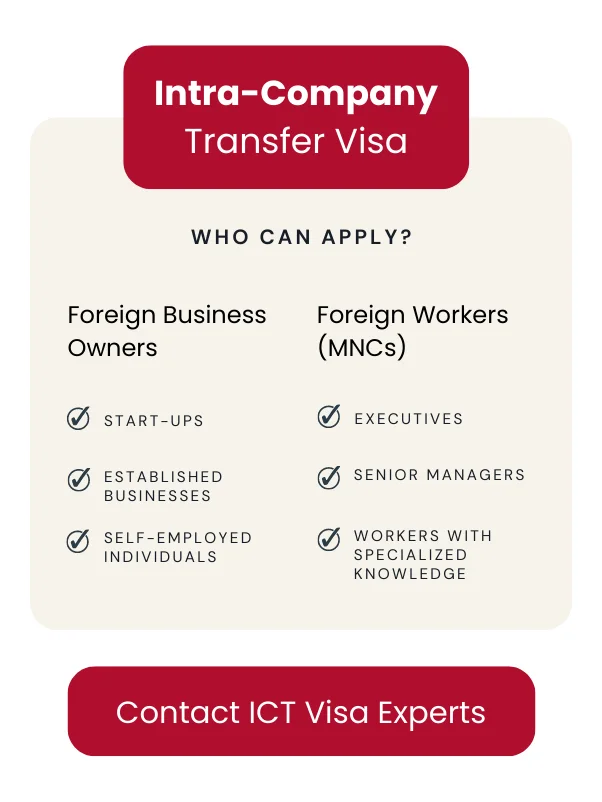
- Position in the Company: Eligible positions typically include executives, senior managers, or employees with specialized knowledge.
- Work Experience: The employee must have been employed continuously (full-time) by the company outside Canada in a similar position for at least one year within the last three years.
- Employment Relationship: The employee must be transferred to a Canadian location to perform similar duties as those performed abroad.
Types of Intra-Company Transferees
- Executives: Individuals who direct the management of the organization or a major component thereof.
- Senior Managers: Employees who manage the organization or a department, supervise other managers or professionals, and have the authority to make significant decisions.
- Specialized Knowledge Workers: Employees whose evidence establishes the required proprietary knowledge and advanced expertise, and why the Canadian role requires it. Ordinary familiarity with an employer is insufficient.
ICT Work Permits for Start-Up Companies
Qualifying multinational businesses may use the relevant ICT category to establish a Canadian enterprise. Simply owning a foreign business and incorporating in Canada does not establish eligibility. Applicants must demonstrate their company’s ability to become established in Canada, including:
- Financial Support: Evidence that the company can financially support the start-up costs and compensate employees.
- Business Plan: A business plan outlining realistic staffing plans and business operations in Canada.
- Physical Premises: Evidence that physical premises have been secured or are in the process of being secured.
- When transferring executives or managers, the company must show it will be large enough to support executive or management functions.
- For specialized knowledge workers, the company must demonstrate it will be actively conducting business and that the work is directed by Canadian management.
Under the general C61 category, a permit to establish a qualifying enterprise has a maximum duration of one year without extension under that code. Any subsequent permit requires eligibility under the appropriate category; a functioning business alone does not guarantee further authorization.
Application Process
Step 1: Prepare the Necessary Documentation
- Proof of Employment: Employment letters detailing the employee’s role, responsibilities, and duration of employment.
- Qualifying Relationship Proof: Documents showing the relationship between the Canadian and foreign branches (e.g., annual reports, business licenses).
- Job Description: Detailed job description of the position in Canada, including duties and salary.
- Proof of Business Operations: Evidence that the Canadian branch is actively conducting business (e.g., financial statements, business plans).
Step 2: Submit the Application
- Follow IRCC’s application instructions for the applicant’s location and eligibility. Visa application centres provide specified support services; they do not decide the application.
- Pay the required processing fees.
- Include all necessary documentation to support the application.
Step 3: Wait for Processing
- Processing times may vary depending on the applicant’s country of residence and the complexity of the application.
- Applicants may be required to attend an interview or provide additional information.
Step 4: Receive the Work Permit
- Once approved, the applicant will receive a work permit, specifying the terms and conditions of employment in Canada.
Benefits of the ICT Work Permit
For Employees:
- Career Advancement: Gain international work experience and broaden professional horizons.
- Family Accompaniment: Spouses and dependent children can accompany the transferee to Canada. Spouses may be eligible for an open work permit, allowing them to work for any employer in Canada.
- Pathway to Permanent Residence: The ICT Work Permit can be a stepping stone towards obtaining permanent residence in Canada through programs like the Express Entry system. An ICT permit does not automatically award 50 or 200 CRS points. Assess any eligible experience or qualifying offer under the current Express Entry rules.
How can Akrami & Associates Immigration Law Firm help?
The Intra-Company Transfer Work Permit is a valuable tool for multinational companies looking to leverage their global talent in Canada. By understanding the eligibility criteria, application process, and potential challenges, both employers and employees can make informed decisions to facilitate successful transfers. This permit not only supports business growth but also offers employees unique opportunities for professional development and career advancement in an international context.
For expert guidance and assistance with your Intra-Company Transfer Work Permit application, Akrami & Associates is here to help. Our experienced team can navigate the complexities of the process, helping identify the evidence and requirements relevant to the proposed transfer. Contact us today to learn more about how we can support your business and career goals.
Contact us today!
416-477-2545
info@thevisa.ca
Choose the correct ICT legal category
ICT provisions under a trade agreement may differ from the general significant-benefit provisions. Identify the applicable category before using a checklist. IRCC’s current general ICT instructions address multinational status, qualifying employment, significant benefit, work location and the proposed Canadian role. This is not a general route for transferring an entire workforce.
What evidence should the business organize?
Prepare an ownership chart supported by corporate records, alongside evidence of actual operations. A company name shared by two entities does not prove a qualifying relationship. Explain who controls each entity and how the Canadian business connects to the foreign employer. For a new operation, identify realistic milestones and the evidence supporting the budget, premises and staffing plan.
Ensure the job description, employment history, organization charts and proposed offer are consistent. Explain the actual duties rather than relying on titles such as director or specialist. If duties have changed, show when and why. A business plan should reflect real commercial intentions rather than generic projections assembled solely for immigration.
Does the employer have a separate submission obligation?
An employer-specific LMIA-exempt application generally requires the employer’s offer submission and applicable compliance fee before the worker applies, unless an exemption applies. The worker should receive the relevant offer information and verify that it accurately describes the proposed employment.
Can family members work automatically?
No. A spouse or partner must qualify under the applicable family work permit rules or relevant agreement. Children’s study and travel requirements also need separate assessment. Plan family expenses without assuming every accompanying person will receive work authorization.
What should happen before the transfer begins?
Check the actual approval and permit conditions, travel documents, proposed start date and any employer obligations. An approval letter may require further steps before the permit is issued. Do not start Canadian employment based solely on a pending application or a corporate transfer letter.
See our ICT services and work permit guidance. Book a consultation with the corporate structure, employment records and intended Canadian role for an individual assessment.
Latest Immigrations News

August 30, 2018
Understanding Intra-Company Transfer
Intra-Company Transfer Are you a foreign national that wants to work in Canada? Do you already work in a multinational company from either the United States or Mexico, which acquires an existing subsidiary branch within Canada? Do you obtain an upper-level position within your multinational company and are [...]

June 4, 2018
About Intra-Company Transferee Work Permits
What is the International Mobility Program? There various different work permits one could apply for which would give them permission to work legally in Canada. The reason there are so many different work permits for individuals to choose from is that the Canadian government recognizes that there are [...]

May 30, 2017
Intra Company Transfer Work Permit Requirements
Intra Company Transferee Work Permit Requirements Do you want to work in Canada but are employed overseas through a multi-national company? Does the multi-national company that you work for have a location in Canada? If so, you should apply for a work permit through an Intra-Company Transfer. It [...]



Book a Conslutation
One of our Representatives will
assist you with your matter. Book Now!
Book a Consultation

Call us for
more Information
+1-416-477-2545
Toll Free: 1-877-820-7121
Contact Our Law Firm

Write Us (Online Form)
Complete our form and one of our
Representatives will contact you.
Send an Immigration Inquiry

Subscribe To Our Newsletter




 1440 Hurontario St
 Whats App: +1 416-477-2545
 Email: info@thevisa.ca