
CANADIAN PERMANENT RESIDENCE
Express Entry Canada: eligibility, CRS and how to apply
Express Entry is Canada’s online system for managing permanent residence applications from skilled workers. Start by finding the program you qualify for, then understand your score, prepare your evidence and plan your next step.
Who is eligible for Express Entry?
You must qualify for at least one of the three federal programs below. You must also meet admissibility requirements and intend to settle outside Quebec. A provincial nomination linked to Express Entry can support your application, but you still need to qualify for a federal program.
On a small screen, swipe across the comparison table.
| Requirement | Federal Skilled Worker (FSW) | Canadian Experience Class (CEC) | Federal Skilled Trades (FST) |
|---|---|---|---|
| Work experience | At least 1 continuous year of paid skilled work within the last 10 years, in your primary NOC. | At least 1 year of eligible paid Canadian skilled work within the last 3 years, with authorization to work. | At least 2 years of eligible skilled trade experience within the last 5 years. |
| Occupation | NOC TEER 0, 1, 2 or 3. | NOC TEER 0, 1, 2 or 3. | Specified eligible trade groups; check your NOC. |
| Language minimum | CLB/NCLC 7 in all four abilities. | CLB/NCLC 7 for TEER 0 or 1; CLB/NCLC 5 for TEER 2 or 3. | CLB/NCLC 5 for speaking and listening; 4 for reading and writing. |
| Education | Canadian secondary education or higher, or an equivalent foreign credential with an ECA. | No minimum education requirement. | No minimum education requirement. |
| Job offer | Not mandatory. | Not mandatory. | A qualifying full-time offer for at least 1 year, or a Canadian certificate of qualification in the trade. |
| Additional test | At least 67 out of 100 on the FSW selection grid. | Student work and self-employment generally do not count; specific exceptions can apply. | Experience must satisfy the trade requirements where it was gained. |
Check the full IRCC criteria for FSW, CEC and FST. The table summarizes eligibility; it is not an individual assessment.
Choose your NOC by your duties
Your job title alone is not enough. Compare the work you actually performed with the occupation’s lead statement and main duties. Keep employment evidence consistent with your dates, hours, pay and responsibilities. Overtime cannot turn a few months of work into a full year of qualifying experience.
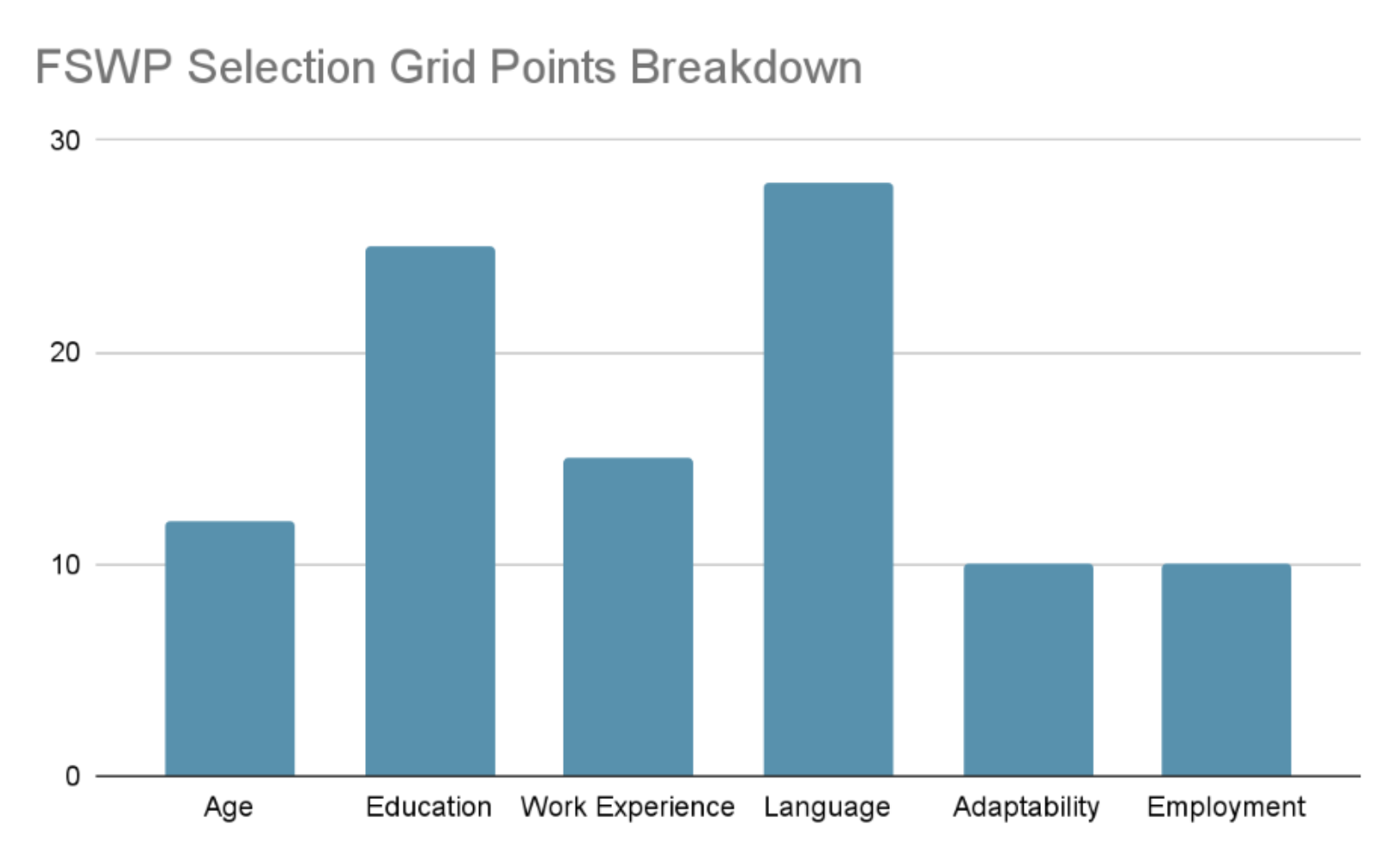
How is the FSW 67-point test different from CRS?
The FSW grid checks eligibility for that program using language, education, experience, age, employment and adaptability. CRS ranks eligible candidates in the Express Entry pool. Passing the FSW threshold does not establish the score needed for an invitation.
How does the CRS score work?
The Comprehensive Ranking System compares profiles in the pool. Factors include age, education, language ability, labour market integration, skill combinations and, where applicable, a spouse or partner’s qualifications. Provincial nomination and other additional factors can affect your score.
Calculate your score using IRCC’s current CRS criteria. Check every claim against evidence you can provide, and update your profile when your circumstances change.
What CRS score do you need?
There is no single permanent cut-off. Each invitation round has its own criteria, number of invitations and minimum score. A past cut-off is useful context, but it cannot predict whether you will receive an invitation.
Check the latest official Express Entry draws →
Category-based selection
IRCC can invite candidates with specified language skills, work experience or other qualifications. Current categories include French-language proficiency; healthcare and social services; STEM; trades; education; transport; physicians, senior managers and researchers with Canadian work experience; and skilled military recruits.
You must meet both a federal program’s requirements and the relevant category criteria. A job title in a targeted field does not automatically qualify you. Confirm the occupation list, experience period and other conditions on IRCC’s category-based selection page.
What can you do if your CRS score is low?
- Review language results: identify whether improving a particular ability would change your score.
- Check your education: confirm that eligible credentials and assessments are represented correctly.
- Assess your household options: compare principal-applicant scenarios if both partners may qualify.
- Explore provincial pathways: check current stream requirements and whether you have a genuine connection to the province.
- Review your experience: count only qualifying work, and update your profile when you actually meet the requirements.
Start with our guides to options with a low CRS score and Express Entry versus provincial nomination. There is no legitimate way to buy a guaranteed invitation.
Language tests and education assessments
Accepted English tests are IELTS General Training, CELPIP-General and PTE Core. Accepted French tests are TEF Canada and TCF Canada. IELTS Academic and PTE Academic are not the Express Entry versions.
Use the required CLB or NCLC level for each ability: speaking, listening, reading and writing. An overall test average does not replace these minimums. Results must be less than two years old when you create your profile and when you submit your permanent residence application. Check IRCC’s accepted tests and score conversions.
An Educational Credential Assessment (ECA) establishes how an eligible foreign credential compares with Canadian education. It is required for foreign education used to meet FSW eligibility and to claim applicable CRS education points. Canadian credentials do not need an ECA. See our credential assessment guide before ordering an assessment.
How much does Express Entry cost?
Creating an Express Entry profile has no government application fee. If invited, budget for the permanent residence fees below plus applicable testing, assessments, medical examinations, police certificates, translations and professional assistance.
| Applicant or service | Amount |
|---|---|
| Principal applicant | $1,590 ($990 processing + $600 right of permanent residence fee) |
| Accompanying spouse or partner | $1,590 ($990 processing + $600 right of permanent residence fee) |
| Dependent child | $270 per child |
| Biometrics, if required | $85 per person; family maximums may apply |
Confirm payment requirements on the official IRCC fee list. Professional fees are separate from government fees.
How much settlement money must you show?
Proof of funds is different from an application fee: it is money available to support your settlement. FSW and FST applicants generally need it. CEC applicants are exempt. Another exemption applies if you are authorized to work in Canada and have a valid job offer, including when applying through FSW or FST.
| Family members | Required funds (CAD) |
|---|---|
| 1 | $15,263 |
| 2 | $19,001 |
| 3 | $23,360 |
| 4 | $28,362 |
| 5 | $32,168 |
| 6 | $36,280 |
| 7 | $40,392 |
| Each additional person | Add $4,112 |
Family size can include a spouse and dependent children even if they are not accompanying you. Borrowed money and property equity do not qualify. Check the complete family-counting rules, bank evidence and any revised amounts on IRCC’s proof-of-funds page.
How to apply through Express Entry
Confirm eligibility and your NOC
Identify the federal program you qualify for and check the work experience, language, education and admissibility requirements before creating your profile.
Prepare your profile information
Complete your language testing and any required ECA. Organize your passport details, employment history, family information and evidence for the points you plan to claim.
Submit an accurate profile
Eligible candidates enter the pool and receive a CRS score. A profile is not a permanent residence application or a promise of selection.
Keep your profile current
Review official invitation rounds and update relevant changes. If no invitation arrives before your profile expires after 12 months, you can submit a new profile if still eligible.
Respond to an invitation to apply
An ITA gives you 60 days to submit your permanent residence application. Recheck your eligibility and points, complete the personalized checklist and pay the required fees.
Respond to IRCC and complete the process
Follow requests for biometrics or further evidence and monitor your account. An invitation does not guarantee approval; follow IRCC’s confirmation instructions if approved.
Read IRCC’s application instructions and deadlines.
Your document checklist
Before creating a profile
- Passport or travel document details
- Valid language test results
- Education records and ECA, where required
- Accurate work history and NOC information
- Job offer, trade certificate or nomination details, if applicable
When invited to apply
- Employment evidence supporting your claims
- Required police certificates
- Medical examination evidence
- Proof of funds or evidence of an exemption
- Civil-status, family and identity documents
- Required translations and any additional personalized checklist items
Medical examinations: if you have never completed an immigration medical exam, current Express Entry instructions require an upfront exam after your invitation and before submission. Some applicants in Canada with a previous exam may qualify to reuse it. Follow the current document instructions and your checklist.
Avoid preventable application problems
Check for mismatched employment dates, an unsupported NOC, expired test results, missing family information and points you cannot substantiate. Explain discrepancies clearly and provide genuine evidence. A polished profile cannot compensate for inaccurate information.
Processing time and your status in Canada
Your timeline has separate stages: preparing documents, waiting for an invitation and processing the application after submission. Time spent in the pool is not the same as IRCC’s application processing time. There is no guaranteed invitation date or approval date.
Use IRCC’s processing-time tool for the current estimate for your application type. Document issues, additional checks and your individual circumstances can affect timing.
Plan separately for temporary status. Creating a profile or receiving an invitation does not extend a visitor, study or work permit. A permanent residence application does not itself authorize employment. Check your status and work authorization well before expiry.
If you have a previous refusal, criminal history or another admissibility concern, address it before relying on an Express Entry pathway. Our criminal rehabilitation guide explains one area that may require a separate assessment.
Express Entry frequently asked questions
Can I apply without a Canadian job offer?
Yes. FSW and CEC do not make a job offer mandatory. For FST, you need a qualifying offer or a Canadian certificate of qualification. You must still meet all other applicable requirements.
Can I apply from outside Canada?
Yes. You can create an eligible profile from abroad. The federal program requirements determine whether your work experience and other qualifications count; being outside Canada is not itself a bar to Express Entry.
Does a high CRS score guarantee permanent residence?
No. Selection depends on the invitation round, and an invited applicant must prove eligibility, claimed points and admissibility. IRCC makes the final decision.
Is the FSW score of 67 the Express Entry cut-off?
No. The 67-point threshold belongs to the separate FSW eligibility grid. CRS ranks candidates after they qualify for the pool. See the program comparison and CRS explanation above.
Do job offers still give CRS points?
Eligible offers can receive points under the November 2026 Labour Market Integration rules. Not every offer qualifies. Check the current IRCC rules linked above instead of relying on articles about the 2025 removal of job-offer points.
Can my spouse and children be included?
You must disclose your family accurately and identify who will accompany you. Eligible accompanying dependants may be included in the application. Review the individual document, examination and fee requirements for each family member.
What if I do not receive an invitation?
Review your score and eligibility, keep your information current and consider suitable provincial or other immigration pathways. You do not become a permanent resident simply by remaining in the pool.
Do I need professional representation?
Representation is optional. An assessment may help you resolve a complicated work history, uncertain NOC, prior refusal, admissibility issue or a deadline. A representative cannot guarantee an invitation or approval.
PLAN YOUR NEXT STEP
Get a clear Express Entry plan
Akrami & Associates can assess your program eligibility, review the basis for your CRS claims and identify document issues before you submit. Bring your language results, education details, work history and any relevant immigration decisions to your consultation.
Book a consultation with Akrami & AssociatesWatch our Express Entry overview
This overview introduces the process. For current rules and amounts, use the updated guidance and official sources above.
Earlier Express Entry guides and FAQs
These archived guides include material from 2015. They are retained for historical reference. Use the current guidance and official sources above for today’s eligibility, CRS rules and fees.
| Title |
|---|
| Express Entry 2015 Comprehensive Ranking System (CRS) criteria |
| Express Entry to Canada FAQ Questions and Answers |
| Express Entry To Canada 2015 FAQ Part 2 |
| Express Entry 2015 FAQs |
 1440 Hurontario St
 Whats App: +1 416-477-2545
 Email: info@thevisa.ca